
Cutting costs more
Cutting connection costs time and effort.
More time to fix things that didn’t land.
More effort to rebuild trust.
More meetings to clear up misunderstandings.
You know this and yet, when a workshop starts running late — tech hiccups, late arrivals, venue glitches — the first thing people want to cut is connection.
I’ve lost count of the number of times I’ve heard, ‘Let’s skip that stuff at the start and get to the meaty stuff.’
Sooooo tempting!
After all, they all know each other, don’t they? Not every time. Not every workshop.
And if they do know each other, how well? Enough to say what they really think? To be real? To collaborate?
The tick of the clock on the wall—and in your head—gets louder & louder.
The easiest option is to cut back the time for people to connect to each other and the purpose of them coming together.
Please don’t.
The minutes you cut connecting are usually the hours you pay for later.
No matter how much time has been lost, the pressure from the clock or people, any group needs time to connect with each other, the topic and you, their facilitator.
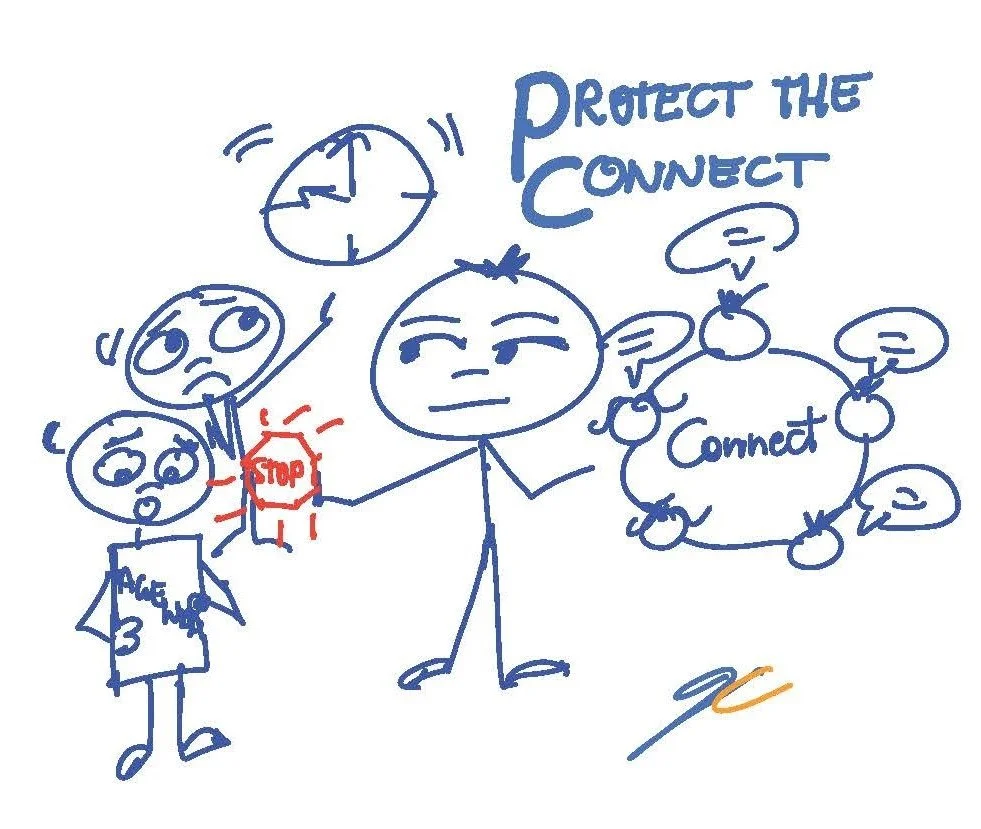
My advice: never cut the connect. Protect it.
Look at what else you can cut to get those minutes back.
Start slow so you can then 'lead at the speed of trust' as Stephen Covey said.
How? My best tip is to remember these three words: protect the connect.
How you invite people to connect, and how long they spend doing this, depends on them and their trust in each other. The options are as varied as the difference between the regular meeting of a long-standing project team and the first meeting of a new partnership.
So, I draw on a range of connection activities. They can feature purposeful questions, solo thinking, chats in pairs or trios, movement and drawing. One of my favourites uses photos, phones and perspective. It guarantees deep connection (that trust), fast (that clock).
No matter how packed your agenda, you can carve out time to connect.
Thanks for reading this far.
Stay (fl)awesome!