
Cover up is denial’s calculated cousin
‘Cover-up’ is denial’s more calculated cousin and ended up costing my client, Trish, her job.
Trish is a dedicated public servant and had started a new job a few years ago full of enthusiasm.
Within two days it was clear something was seriously off. The team dynamic was toxic. The previous Director’s behaviour had been worse.
Trish went back to the person who had interviewed her.
‘I asked you if I was walking into a hornet’s nest in my second interview. Did you lie?’
‘Yes’ was her sheepish reply. She apologised for not telling Trish something so vital about the team.
She took it higher to the Executive Director. He fiddled with his tie when she asked him what was going on with the team. When Trish said she was tempted to leave, he begged her to stay.
It became clear that the Executive Director, the interviewer and the whole branch had not confronted the problems with Trish’s predecessor and the team. They had managed their way around it and brought in Trish hoping the problem would somehow resolve itself.
It didn’t and eighteen months later, the same behaviour landed on her. Trish was bullied by the team. They had learned that their behaviour with the previous Director had no consequences.
The cover-up didn’t just hide the problem. It reinforced it.
Cover-up and denial
Denial can be a reflex. It can happen before you’ve decided (remember your mouth moving faster than your brain?).
Cover-up, by contrast, feels more like a conscious decision. You know what happened. You calculate what to reveal and what to conceal. You buy yourself time, plan the fix, tell yourself no one needs to worry unnecessarily.
Sometimes it works—like when I got the dinged door on mum’s car fixed (last week’s video)—and I think that’s why it’s tempting to keep on doing it.
We learned to cover up early
My early educator friends tell me that children learn to cover up when they’re about three or four. It’s the moment they realise that ‘I know something you don’t know’.
The instinct is identical whether you’re four or forty: avoid punishment, avoid shame, avoid being seen as incompetent.
We don’t necessarily outgrow it. We just develop more sophisticated tools, ‘controlled narrative’ experienced by Trish in her new job.
Cover-up causes us to drift, not learn
Cover-up doesn’t just hide the mistake, it locks in the conditions that created it. Little gets examined or addressed. The dynamic in Trish’s new team, for example, remain unchanged. They didn’t learn or grow, they drifted.
Protect or postpone
It’s unlikely that the ED or the interviewer was being malicious by covering up the hornet’s nest from Trish. They may have been protecting the branch.
Cover-up can protect, like it did me from my mum. Or it can postpone the inevitable discovery, like Trish with her team.
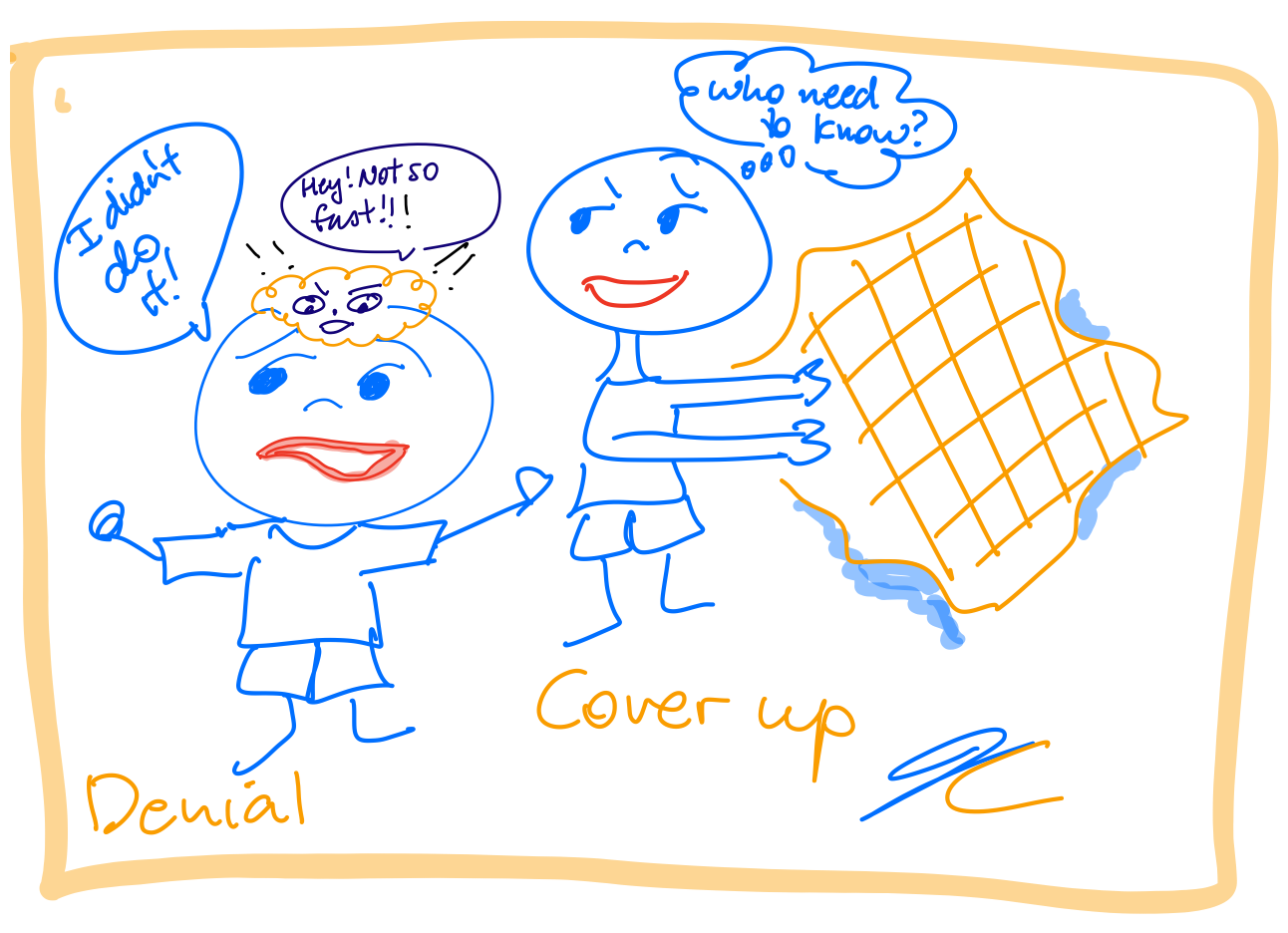
Meet the cousins © Jacinta Cubis
An alternative is owning up. Next time, I’ll share a story of what that looks like and why it can be harder than it sounds, even when you know it’s the right thing to do.
- - - - -
This blog is part of a series exploring how we respond to failure — from denial all the way through to learning. If you missed last week’s video, watch it [HERE].
Thanks for reading this far!
#FlawesomeFacilitator #Mistakes #Protection #Failure #Imperfection