
When the mouth moves faster than the brain
Have you ever said something and watched it come out of your mouth, slightly horrified, unable to stop it?
I know that caught-in-the-moment feeling. The hot cheeks, the tightening chest. The words already out there before the brain has caught up.
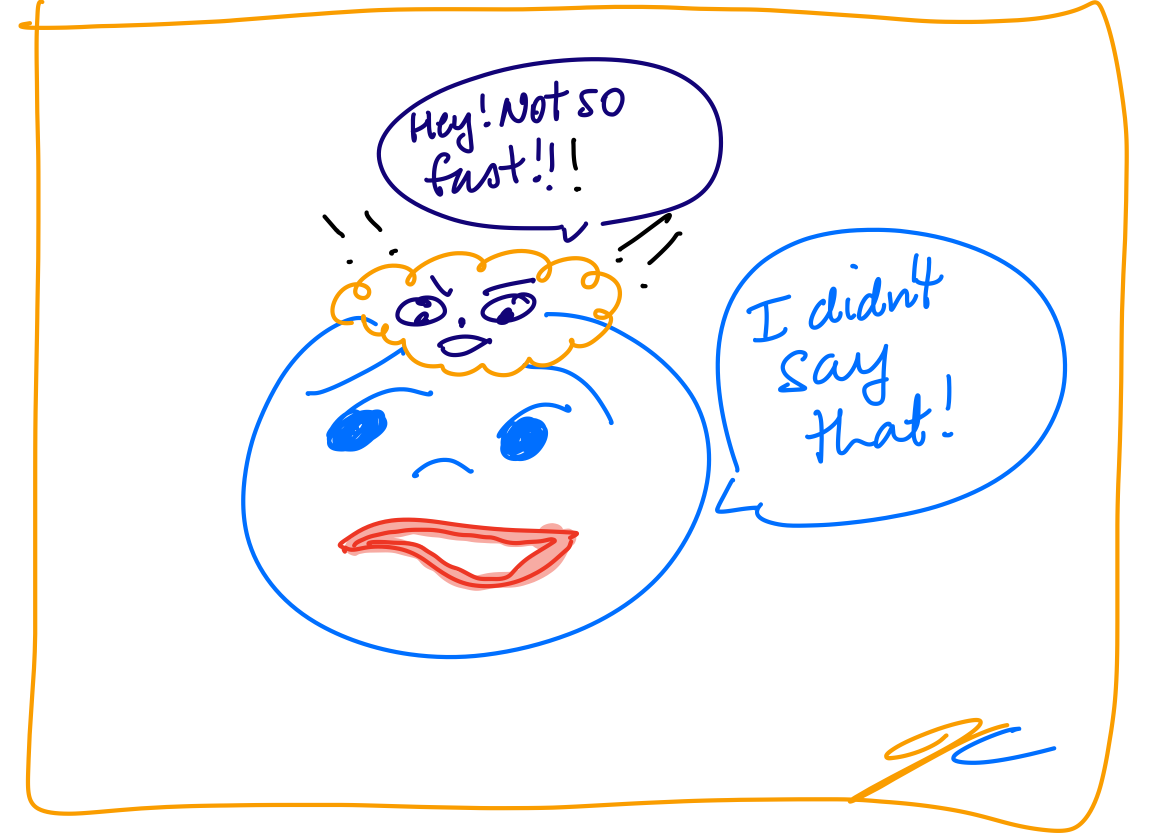
© Jacinta Cubis
I wonder if that’s what happened to the senior academic I talked about last week.
I can imagine how she might have felt caught out when the Dean confronted her about her unguarded comment to a journalist. Her denial may not have been a calculated move. She was probably acutely embarrassed, and it was a very human reflex to deny that she had been critical of the university’s leadership to the journo.
One unguarded comment, one person who overheard, and maybe everything she had built her reputation on felt at risk. Of course she denied it.
Amy Edmondson’s research helps explain what drives denial of our mistakes and stuff ups.
Why we deny — even when we know we’re wrong
Edmondson is a Harvard professor who has spent decades researching how teams learn and how they don’t. She says that:
‘To avoid being thought of as incompetent, we don’t admit weakness or mistakes.’
There’s fear underneath the denial. It doesn’t point to dishonesty as a character trait, just a very human instinct. As Edmondson puts it,
‘It is an instinct to want to look good in front of others.’
She calls this ‘impression management’ and it’s become second nature by the time we’re working adults.
The higher up the ladder you are, the more status you’ve accumulated, the more reputation you have to protect. Just like the senior academic in my story.
Edmondson encourages senior people to be the first to acknowledge their own fallibility, to acknowledge that they are human.
What denial actually costs
One cost is that denial can be infectious. When leaders deny, they set the standard for everyone watching. Denial at the top tells everyone below that mistakes are not safe here.
Another cost is credibility with the people who know the truth. Like the junior colleague who overheard the academic’s unguarded comment to a journalist. What did he tell his colleagues?
The slow cost is harder to see. Trust erodes quietly. People just stop giving you the benefit of the doubt. Stop sharing things with you. Stop recommending you for things. You don’t notice trust is gone until it is.
Denial doesn't erase the mistake. It might buy the denier a little time and someone will know, even if that someone is only them.
Denial is different to covering up
Denial tends to be reflexive and happens in a moment.
Covering up, another response to failure, is a bit different. You know you’ve made a mistake and choose to conceal it. It feels more considered than denial.
Next week: why cover-up feels like protection and what it actually costs.
Thanks for reading this far!
Stay (fl)awesome!